
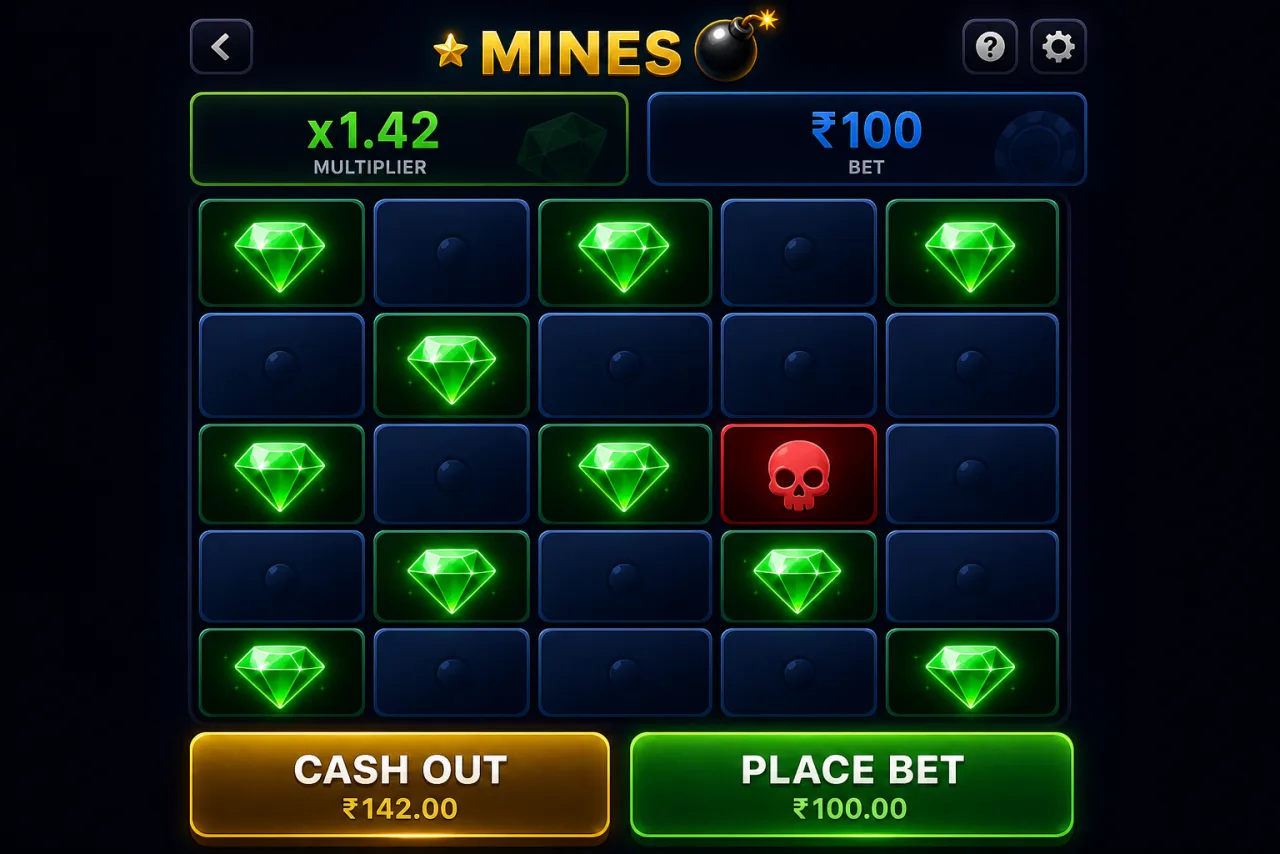
1. What is Mines?
Mines is Daman Games' take on the classic Minesweeper-style gambling game. On a 5×5 grid of 25 tiles, the game places a set number of hidden mines (bombs) — you choose how many before each round. The remaining tiles contain gems. Your goal is to reveal gems without hitting a mine.
Each gem you reveal increases your multiplier. You can cash out at any point to collect your current winnings. If you hit a mine, you lose your entire bet. The game ends either when you cash out or when you hit a mine.
2. How Mines works — the mechanics
- Set your mine count: Choose 1 to 24 mines before the round. More mines = higher multipliers per tile, but higher mine risk per flip.
- Place your bet: Enter your stake amount for the round.
- Start the game: The 25 tiles become active. The mine positions are determined by the server-side RNG at this point — before you flip any tile.
- Flip tiles: Click or tap any tile. If it's a gem, your multiplier increases. If it's a mine, the game ends and you lose your bet.
- Cash out: At any point after revealing at least one gem, tap Cash Out to collect your current multiplier × stake.
3. The probability math behind every flip
At the start of a Mines round with M mines and 25 total tiles:
- Probability your first flip is a gem: (25 − M) / 25
- Probability your second flip (after a safe first) is a gem: (25 − M − 1) / 24
- And so on — each safe flip reduces the remaining unknown tiles by one and reduces the remaining gems by one
Example (3 mines, standard difficulty):
- First flip: 22/25 = 88% chance of a gem
- Second flip (after first safe): 21/24 = 87.5%
- Third flip: 20/23 = 87%
- But to survive all three: 0.88 × 0.875 × 0.87 = 67.1%
Multiplying sequential probabilities reveals why longer runs are genuinely risky even at low mine counts: each additional tile compounds the cumulative risk.
4. Mine count vs multiplier table
| Mines | Safe tiles left | P(1st safe) | Typical 1-tile multiplier | P(5 safe in row) |
|---|---|---|---|---|
| 1 | 24 | 96% | 1.04× | 80% |
| 3 | 22 | 88% | 1.14× | 54% |
| 5 | 20 | 80% | 1.25× | 33% |
| 10 | 15 | 60% | 1.67× | 8% |
| 20 | 5 | 20% | 5× | 0.03% |
Multipliers shown are approximate fair-value multiples. Actual Daman Games multipliers are slightly lower (house edge removed). Always check in-app.
5. The house edge — where it hides in Mines
In Mines, the house edge is embedded in the multiplier table. A "fair" game would pay exactly the statistical expected value for every sequence of safe tiles. Daman Games pays slightly less.
Example (3 mines, 1 tile flipped safely): the fair expected value means the payout should equal approximately 1.136× (25 ÷ 22). Daman Games displays a lower multiplier — typically in the range of 1.08–1.12×. The difference between the fair value and the offered value, compounded across every flip, represents the house edge.
6. The cash-out trap: why "one more tile" costs you
The most dangerous aspect of Mines is the cash-out mechanic. After a successful flip, you see a growing multiplier and the temptation of "just one more tile" becomes very strong. This is called the sunk-cost escalation — you've already committed, the multiplier is rising, and stopping feels like "giving up."
The mathematical reality: your probability of losing on the next tile increases with each safe tile you've already flipped (fewer safe tiles remain, same number of mines). The more successful flips you've had, the higher the mine concentration in the remaining tiles.
Example (5 mines, after 10 safe flips): You've revealed 10 gems. 15 tiles remain hidden, 5 of which are mines. Your next flip has a 1-in-3 chance of a mine — much higher than at the start (1-in-5). The game is actually getting riskier as you continue, not safer.
7. Why Mines is not a skill game
Mines markets itself — and feels — like a skill game. You make decisions: which tile to flip, when to cash out. But consider:
- Tile position is random: Mine positions are assigned by the server's RNG before you flip anything. Your intuition about "corners are safer" or "the middle has more gems" has zero basis in the game's math — mine placement is uniform.
- Pattern recognition is meaningless: Players study previous Mines results looking for spatial patterns. Since each round is independently generated, any pattern is coincidental. The Gambler's Fallacy applies directly.
- Cash-out timing is not skill: The "optimal" cash-out time is statistically before any flip (since each flip has a negative expected value with the house edge). The feeling of "I knew when to stop" is confirmation bias — you remember the times you stopped early and won, and forget the many times you went one tile too far.
8. Our Mines verdict
Mines rating
- Entertainment value3.5
- Fairness (house edge)2.0
- Transparency1.9
- Ease of play4.4
9. Frequently asked questions
How does the Mines game work?
Mines is played on a 5×5 grid of 25 tiles. Before each round you choose how many mines to place, from 1 to 24, then place your bet and start the game. At that moment, the server-side RNG fixes the position of every mine — before you have flipped a single tile. You then tap tiles one at a time; each tile that turns out to be a gem increases your multiplier, and you can cash out at any point after revealing at least one gem to collect your stake times the current multiplier. If a tile you flip is a mine, the round ends immediately and you lose your entire bet for that round. The mine count you choose changes the odds: fewer mines means a higher chance of a safe flip but a smaller multiplier per tile, while more mines means bigger multipliers per flip but a much higher chance of hitting a mine early.
What's the safest number of mines to pick?
There is no mine count that is truly "safe" in the sense of favouring the player, because the house edge of roughly 3–7% is present at every mine count — it is simply structured differently. Picking a low mine count, such as 1 or 3, gives you a high probability of a safe flip (96% and 88% respectively for the first tile) but pays a very small multiplier per gem, so the potential reward is limited. Picking a high mine count, such as 20, gives a small chance of survival per flip but pays dramatically more per gem when you do succeed. Neither approach changes the underlying expected value, which remains negative for the player across thousands of rounds. If your goal is simply to reduce the frequency of losing rounds and play for longer, a low mine count with an early cash-out habit reduces variance. It does not, however, create a profitable strategy.
Can you predict mine locations?
No. Mine positions are assigned by the server-side RNG the instant you press Start, before you have flipped any tile, and they are placed uniformly at random across the 25-tile grid. Common beliefs like "corners are safer" or "mines cluster in the middle" have no basis in how the game generates positions — every unrevealed tile has an equal underlying probability of being a mine given the mine count you selected. Players who study screenshots of past rounds looking for spatial patterns are falling for the gambler's fallacy: each round is generated independently, so a mine appearing in the top-left corner in one round has no bearing on where mines appear in the next round. Any app, bot, or Telegram channel claiming to predict Mines tile positions in advance is not describing a real capability — it cannot access the server-side RNG output before the round starts, because that information does not exist until the mines are placed.
What's the max multiplier on Mines?
The maximum multiplier depends on how many mines you select and how many gems you reveal before cashing out — the fewer safe tiles remain, the higher each additional flip pays. At the extreme end (a high mine count like 20, with only 5 safe tiles on the board) a single successful flip can pay around 5× your stake according to the fair-value table used in this guide, and multipliers compound further with each additional safe flip, though surviving multiple flips at that mine count is extremely unlikely — the probability of five safe flips in a row at 20 mines is roughly 0.03%. Daman Games' actual displayed multipliers run slightly below these fair-value figures because the house edge is built into the payout curve. There is no fixed universal maximum multiplier advertised for Mines; the highest multipliers exist mathematically but are reached so rarely that they are not a realistic basis for a betting plan.
Is Mines a game of skill?
Not in any way that changes the outcome. Mines feels like a skill game because you actively choose which tile to flip and when to cash out, but the mine positions are fixed by the RNG before you make a single choice, so tile selection cannot improve your odds — every unrevealed tile carries the same underlying probability. The only genuine decision you make is when to stop, and even that decision does not carry positive expected value, because every additional flip has a negative expected value once the house edge is factored in. What players experience as skill is closer to confirmation bias: they remember the rounds where they stopped early and avoided a mine, and forget the many rounds where stopping even earlier would have preserved more of their winnings, or where continuing cost them everything. The game rewards the feeling of control far more than it rewards actual decision-making, which is part of why it is engaging.
What happens if I hit a mine?
If you flip a tile that turns out to be a mine, the round ends immediately and you lose your entire stake for that round — there is no partial refund based on how many gems you had already revealed. This is why the cash-out decision matters more than tile selection: once you have flipped several safe tiles and built up a multiplier, that multiplier only becomes real money the moment you tap Cash Out, not before. If you keep flipping after building a strong multiplier and then hit a mine, you lose everything accumulated in that round. Because the remaining mine density increases with every safe flip you make, the risk of hitting a mine rises the longer you continue a single round. Setting a target number of flips before you start, and cashing out at that target regardless of how "safe" the round feels, is the only reliable way to lock in winnings before a single unlucky flip erases them.